
La rehabilitación es un proceso complejo que necesita tiempo, dedicación y control. Las variantes de estos tres pilares varían de acuerdo al paciente, pero las reiteradas visitas a un hospital o consultorio para llevarla adelante pueden disminuir la motivación de los pacientes. Para evitar esto y aumentar los resultados positivos en el proceso, la compañía española Indra desarrolló Toyra.
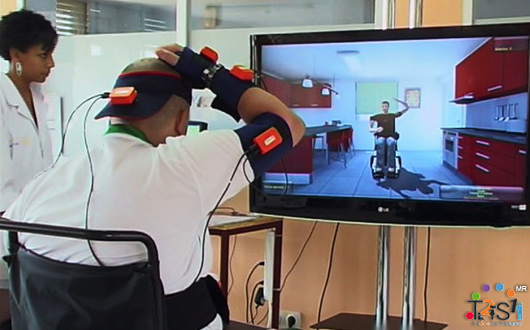
Toyra es un sistema que combina la realidad virtual con la captación de movimientos en tiempo real, para la rehabilitación motriz de miembros superiores como hombro, brazo, antebrazo y mano, permitiendo a los pacientes hacer los ejercicios de rehabilitación desde su hogar.
Esta metodología está basada en tecnologías como la Kinect de Microsoft y sensores inerciales que toman la posición y ubicación del paciente a fines de recrear sus movimientos. Una vez que el paciente está conectado, el sistema elabora un avatar que recrea todos los movimientos que éste realiza.
Esta captura de movimientos funciona como fuente de información sobre el nivel de rehabilitación en el que se encuentra la persona y el progreso que hace en el tiempo. Para ello, la plataforma lleva un registro de los ejercicios realizados y cómo fueron hechos para que los médicos puedan hacer un análisis del progreso e ir mejorando los ejercicios a medida que la rehabilitación avanza. Cada uno de los ejercicios fue diseñado por especialistas en el cuidado de la salud que se desempeñan específicamente en el campo de la rehabilitación de personas parapléjicas.
Toyra está pensado para formar parte de una institución, instalado en sus servidores privados, o bien en uno al que médicos y pacientes ajenos a éstas puedan acceder. En torno a esto, la plataforma está disponible en ‘la nube’, ofreciendo a los profesionales actualizaciones del sistema de manera inmediata y sin costo adicional.
Esta herramienta se utiliza desde 2011 en el Hospital de Parapléjicos de Toledo con ‘resultados positivos y permite la ejecución de ejercicios terapéuticos de manera interactiva, incentivando la motivación del individuo respecto a su tratamiento. En 2013, con la incorporación de la tecnología en ‘la nube’, se impulsa la deslocalización de los tratamientos que permita la rehabilitación de manera remota una vez que se ha dado de alta al paciente.
Finalmente, Toyra cuenta con dos modalidades diferentes: Toyra Autónomo y Toyra Asistido. Mientras que la primera está orientada a pacientes que han logrado un grado de autonomía que les permite ejecutar las terapias por sí mismos, la segunda está pensada para ejecutarse en la fase inicial del proceso de rehabilitación en entornos hospitalarios.
¿Qué opinas sobre esta nueva metodología para rehabilitar pacientes?
Fuente: Noticias.tudiscovery.com


Sound Effects Editors: Steven Avila, Alexander Pugh, & Peter Daniel Lago, MPSE
An agoraphobic father teams up with a renegade priest to save his daughter from the clutches of a gang of twisted feral children. Cast: Anuerin Barnard, James Cosmo, Wumni Mosaku, Jake Wilson, Amy Shiels (World Premiere)
I chatted extensively about the film with a number of the aforementioned guests over dinner and dessert. The most common reactions (spoiler alert): Several moments of the film — like other Spielberg films that involve war, including and especially Schindler's List (1993) and Saving Private Ryan (1998) — are so disturbing that some viewers had to look away, in particular the scene in which the horse becomes entangled in barbed wire while running through no-man's land (producer Kathleen Kennedy told me during a Q&A that I moderated on Saturday with many of the film's below-the-line contributors that it was not actual wire, the horse was never at risk of injury, and an animal-rights rep was always on set). Several moments of the film — like other Spielberg films that prominently feature children, including E.T. (1982) — are emotionally powerful enough to move even the gruffest of men to tears, particularly the scene in which a temporarily-blinded Albert is reunited with Joey, as well as the film's final scene in which Albert and Joey return to Albert's family farm after the war and Albert is embraced by his parents. (Spielberg is the master at tugging at the heartstrings, and one of his trademark themes is parents and children growing to accept one another.) PHOTOS: Steven Spielberg on Set Some of the acting is a bit stilted — Irvine, making his big screen debut, is a bit stiff; Buckens, though lovely, has a scene with a single tear that is a bit much; and the young actor who plays Albert's friend and says on several occasions "Well, look at you," is more than a little grating. Williams' score, while beautiful, is somewhat "derivative" and used too much to guide viewers' emotionals. PHOTOS: 23 Awards Contenders Featuring Animals
AL I thought I should try and make this song appealing to more than just my fans, so I contacted as many artists as I could think of. I thought, if I can get these successful female singers talking about the single and the reasons behind it on their websites, it will be a start. This is a lifelong commitment; I want to devote